Article
Jul 28, 2026
We Blind-Scored 473 Pages Ranking on Google for B2B SaaS Terms. Content Quality Explained Almost Nothing.
A blind study of 473 top-ranking B2B SaaS pages: content quality had near-zero correlation with rankings (-0.045), backlinks predicted position 4x better, and 60% of the winning content reads as AI-generated.
A payroll company ranks third in Google for a term its buyers type before they buy. The page has a sentence in it that reads "can autonomously agents to qualify leads." A customer-support vendor ranks third for "zendesk alternatives" with the phrase "our the AI AI" sitting in the body, plus a comparison table that promises a competitor it never covers. One page we pulled, ranking on the first screen for a real buying query, had its entire body replaced with Lorem ipsum. Latin placeholder text. Nobody at the company read it before it went live, and it ranks anyway.
We kept finding pages like this, so we stopped guessing and measured it.
We took 150 queries a B2B software buyer actually types, the "best [category] software" and "[competitor] alternatives" and "how to [do the job]" terms across 33 software categories, pulled the pages Google ranks in the top 10 for each, and scored them blind. 473 pages. Every brand name and URL stripped. A panel of independent editorial judges read one page at a time, knowing nothing about who wrote it or why, and scored each on evidence, originality, honesty, craft, and citability. We calibrated the panel against 15 articles published in 2021, before ChatGPT existed, to prove the judges could tell human writing from machine writing. They flagged zero of the 15 as AI.
Then we correlated the quality scores against where each page actually ranks.
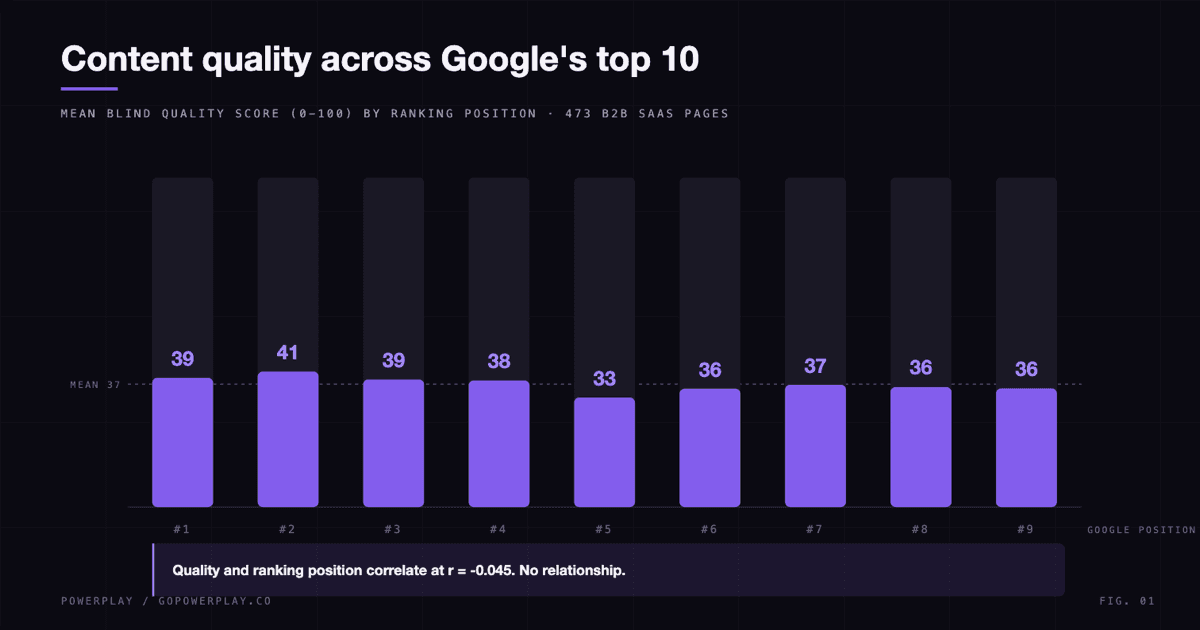
The correlation between content quality and Google ranking position was -0.045. On a scale where 1 is a perfect relationship and 0 is none, that is none. Across 473 pages, the quality of the writing has no measurable bearing on where it ranks.

The pages winning are mediocre, and it is not close
The median page ranking for these buying terms scored 36 out of 100. Half the pages Google puts in front of buyers for commercial queries are below that. Out of 473 pages, 9 cleared 70. When we asked the judges the simplest question, "as an expert, would you cite or recommend this page," they said yes to 9%.
91% of top-ranking B2B SaaS pages would not be cited or recommended by an expert who read them. Median quality score: 36 out of 100.
Pages sitting at position one, two, and three averaged a quality score of 40.8. Pages at four through ten averaged 39.7. The content winning by a lot is exactly as mediocre as the content winning by a little. Whatever is deciding these rankings, it is not reading the page the way a person does.
What actually predicts rank
We pulled the backlink data for 284 of these pages and correlated that against position too. Referring domains, the count of other sites linking to a page, correlated with ranking at -0.19. Weak in absolute terms, but roughly four times stronger than content quality, and statistically real where quality was not. Domain authority did similar work.
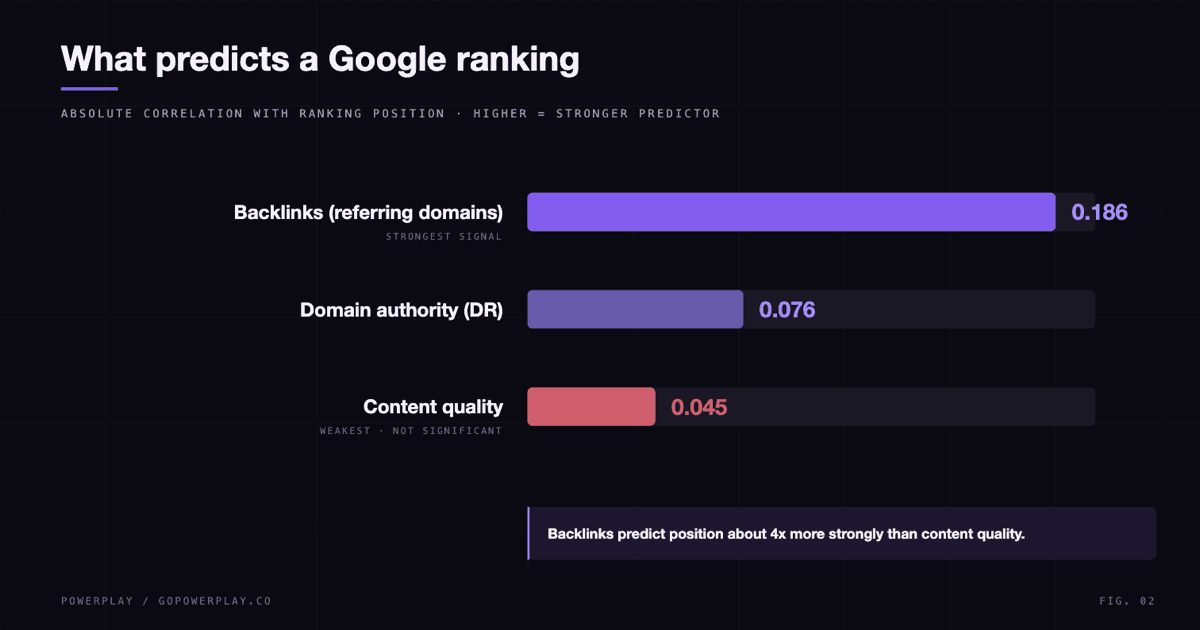
Backlinks predict Google ranking position roughly 4x more strongly than content quality, which was the weakest of every factor we measured and not statistically distinguishable from zero.
The cleanest number in the whole study is this one. Among the pages ranking for these terms, the ones we scored below 40 on quality have a median Domain Rating of 81. The ones we scored 55 and above have a median Domain Rating of 84. Functionally identical. The authority that is actually ranking pages is spread evenly across good content and bad. "Write great content and you will earn the links" is a story the industry tells itself, and it is not visible anywhere in this data. High-authority sites publish mediocre content and rank it on the strength of the domain.
Yes, it is mostly AI. No, that is not the story.
60% of the top-ranking pages read as substantially AI-generated to our judges. We can state that number with a straight face because the same judges flagged 0 of 15 known-human articles as AI. The false-positive rate is zero. When they say a page is machine-written, the calibration says they are right.
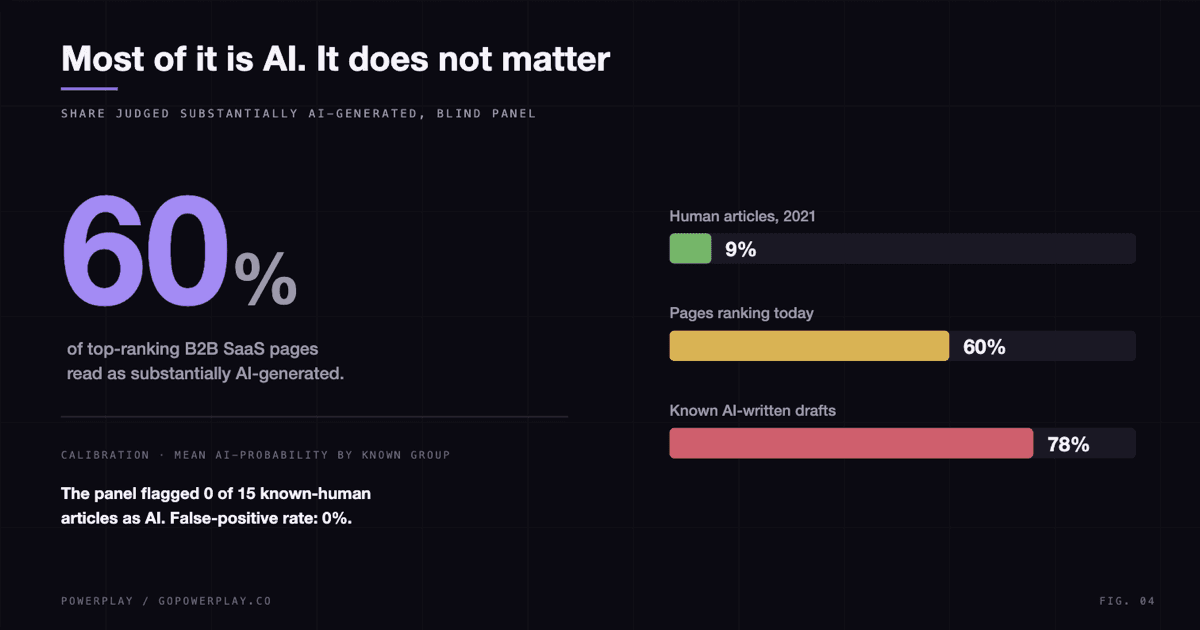
The interesting part is what AI-generation predicted, which is almost nothing. AI pages did not rank better than human pages, and they did not rank meaningfully worse. Google's own AI Overview cited AI-written pages slightly more often than human ones, not less. The debate about whether AI content is allowed to rank has a clear answer in the data, and the answer is that Google stopped caring and its own AI feeds on the machine-written pages at least as readily as the human ones.
Here is the number that should end the moral panic. We scored the 2021 human content on quality too, the same rubric, blind. It averaged 40.7. The AI pages ranking today averaged 37.3.
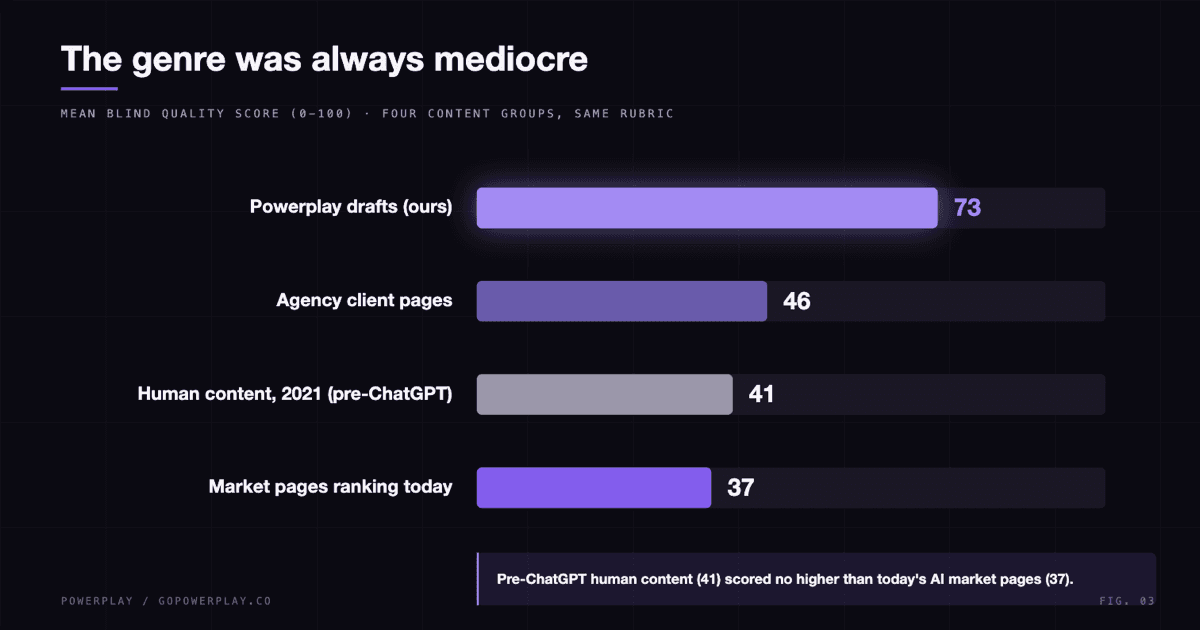
Human-written B2B content from before ChatGPT existed scored 40.7. The AI pages ranking today scored 37.3. AI did not lower the quality bar. It removed the cost of clearing a bar that was already on the floor.
The golden age of handcrafted B2B content that AI supposedly ruined did not exist. We have the scores.
What this means if you run marketing
Most content teams are pouring budget into the one variable this study could not connect to any outcome. Editorial quality, the thing a good writer sweats over, is table stakes at a shockingly low threshold, and above that threshold it does not move rankings, it does not move AI citations, and the market does not price it.
That does not mean publish slop. It means quality earns you the three things the ranking does not measure, and you should be honest with yourself about which game you are playing.
Rankings are won by targeting the right query, earning links and authority, and structuring the page so a machine can lift the answer. That is the game for Google, and the data is unambiguous about it.
Getting recommended is a different game, and it is the one worth caring about now. Google ranks pages. AI engines recommend brands, and they do it by cross-checking claims across sources before they name anyone. An answer engine that finds your unsourced stat range contradicted by three other pages drops you. The pages full of "industry estimates suggest" and copy-pasted competitor blurbs are the ones ranking today and the ones most exposed tomorrow. Grounding every claim in something true, what we call the receipts principle, is the only hard part of this that is left, and it is the part almost nobody does.
And then there is the buyer, who is not a search algorithm. A page can rank, get the click, and still lose the deal because a director read it and clocked that it was written by nobody about nothing. Quality shows up in conversion, which no ranking study measures, including this one.
The study, by the numbers
473 pages scored, ranking in Google's US top 10 across 33 B2B SaaS categories
-0.045 correlation between content quality and ranking position
36 / 100 median quality score of the pages winning these terms
9% of pages an expert would cite or recommend
4x stronger: backlinks predict rank versus content quality
60% of top-ranking pages read as substantially AI-generated
0% false-positive rate on 15 known-human control articles
518 total pieces scored across the market, agencies, controls, and our own drafts
2.5 points average disagreement between judges on a 100-point scale
Where we lost, and what we cannot claim
We ran our own drafts through the same blind panel. They scored well, a mean of 73 against the market's 37, which is the result you would expect from an agency grading its own homework and is not the point of publishing this. The point is that four of our own pages earned zero "would cite" votes, and the judges flagged our listicle format for ranking ourselves first with the softest criticism on the page, the same move we called out in everyone else. We are not exempt from the pattern. We are inside it.
On method, three honest limits. We scored pages that already rank, so we can say quality does not separate the winners, and we cannot say quality is useless for becoming a winner in the first place. Our quality judges are a calibrated AI panel, not a room of human editors, though the quality finding only needs the rank-ordering to hold, not the absolute scores, and 69 double-scored pages agreed within 2.5 points out of 100. And this is one snapshot of US results in mid-2026, not a law of nature. The full methodology, the rubric, and the page-level scores are available if you want to check our work.
The takeaway is not that content does not matter. It is that the industry has been optimizing the wrong variable, measuring craft while rankings run on links and authority and AI recommendations run on grounding and consistency. The teams still hand-writing everything as a point of pride are paying a premium for a quality the market does not measure. The teams pumping ungrounded AI volume are ranking today on borrowed authority and are one algorithm update from the reckoning. The work worth doing sits in neither camp: produce with AI, target with intent, and ground every claim in something a machine can verify and a buyer can trust.
Unlock your top growth channel
Book a call to start driving pipeline through AI search.